
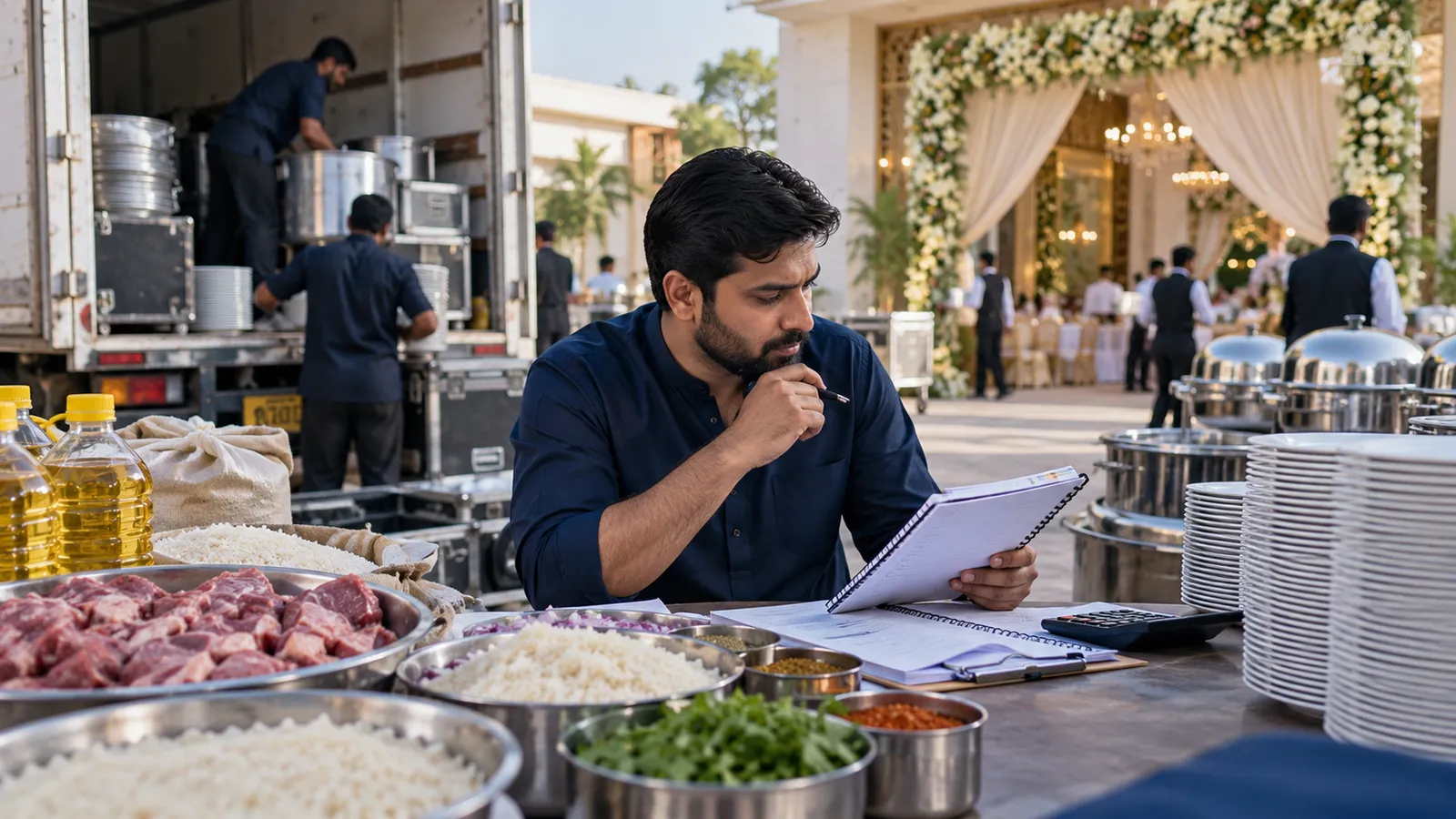
A family books you for a mehndi of four hundred guests and a valima a week later. The menu is agreed over two visits and twenty WhatsApp messages, an advance is paid partly in cash and partly by transfer, and the guest count changes three times. On the day, your cooks need the right quantity of rice, meat and oil, the waiters need to be booked, and the deg, chafing dishes and crockery must leave the godown. Then the balance has to be collected. This is where most caterers run on a diary and a good memory.
What a catering business actually needs to track
| Stage | What is recorded | Who uses it |
|---|---|---|
| Enquiry | Client, function type, date, venue, rough guest count | Owner or sales |
| Booking | Agreed per-head menu, final price, advance and its mode | Owner, accounts |
| Planning | Ingredient list scaled to guests, purchase list, staff and crockery list | Head cook, store |
| Function day | Dispatch of deg and crockery, staff attendance, extra dishes added | Supervisor |
| Closing | Balance collected, crockery returned or broken, actual costs | Accounts, owner |
Per-head menus that cost themselves
Most Pakistani caterers price per head: so many dishes, one sweet, salad, raita, naan, cold drinks. The trouble is that the cost of a chicken karahi for three hundred people changes with the rate of chicken, and the owner rarely recalculates. The fix is a recipe for every dish, written for a fixed number of guests. When a booking says four hundred guests, the system scales each recipe and adds up the purchase list. Enter today's rates, and the cost per head appears beside the price you quoted.
That list also goes to the store and the buyer, so the cook is not guessing how many kilos of rice to order from the market. Leftover stock goes back into the store record for the next function.
Advances, balances and changed guest counts
The advance is easy to remember; the balance is not. Each event should carry its own small ledger: advance, any extra dishes or extra guests added on the day, discounts given, and the final amount collected in cash, by bank transfer, JazzCash or EasyPaisa. A daily list of events with balances outstanding is the most useful report a caterer can have. If you already issue proper bills, our guide to invoicing software in Pakistan explains what a clean invoice should carry.
Staff and equipment for each function
Waiters, cooks and helpers are often daily-wage staff. The event file should list who was sent, so wages are paid per function without argument. The same goes for equipment: deg, chafing dishes, plates and glasses go out on a list and come back counted, with breakage charged to the event.
Fix a base guest count
Write each dish's recipe for one hundred guests, with raw quantities in kilos and litres.
Add today's rates
Enter current market rates for meat, rice, oil, spices and disposables, and update them when they move.
Add the fixed costs
Include cooks, waiters, transport, gas and crockery wear for a function of that size.
Scale to the booking
Let the system scale every recipe to the booked guest count and total the cost per head.
Record the actuals
After the function, enter what was really bought and paid, and compare it with the estimate.
Keep the menu and rate agreed in writing inside the event file, and send the client a copy on WhatsApp. When a family later says the price included cold drinks or an extra sweet, the record settles it in a minute, without souring a client who may book you again for the next wedding in the family.
Busy season and the calendar
In wedding season a caterer may run several functions on one evening. A calendar of booked dates, with guest counts and venues, stops double booking of cooks and equipment and shows which days still have room. Caterers who work with halls will also want to read our guide to marquee and banquet hall software, since the two often share a client.
Is this an ERP or just an app?
For a small caterer, a booking-and-costing app is enough. Once you have a store, purchases, staff wages and accounts to keep together, it becomes a small ERP. Our page on ERP modules explains which parts to start with. A caterer serving a restaurant from the same kitchen may also need a POS; see the restaurants industry page.
Operix builds ERP software in Pakistan from Karachi, with every screen shown before it is built and training in Urdu or English. Book an ERP demo and bring one recent event's menu and bills.
Questions people ask
Can the software handle a guest count that changes after booking?
Yes. When the count changes, the recipes rescale and the purchase list and cost per head update. The price change and any extra charge are recorded against the same event.
Can my cooks use it in Urdu?
Screens and printed lists can be in Urdu, English or both. Many caterers keep the purchase list in Urdu for the market and the bill in English for the client.
What does catering software cost?
It depends on which parts you need: bookings, costing, store, staff, accounts. Operix does not publish prices; you get a written quote with milestone payments after a discovery call.
Do you work with caterers outside Karachi?
Yes, online. Operix has no office outside Old Clifton, Karachi; Karachi caterers get on-site setup, and caterers elsewhere are set up and trained online.