
You have asked three companies for an ecommerce website quote and received three figures that do not resemble each other. That is not because one of them is cheating. An online store is a bundle of separate pieces, and each quote has silently included a different set of them. This guide lists the pieces so you can ask everyone for the same store. It covers stores only; the cost of a company website in general is in our guide to website development cost in Pakistan. Starting prices are on our pricing page; what follows is what moves a quote above them.
The pieces of a store that cost money
Design
A store on a ready theme with your logo and colours costs less than one designed from scratch around your products. The ready theme is the right choice for most first stores. Custom design pays off for a brand whose look is the reason people buy, and for products that need a particular way of browsing, such as fabric by the metre or furniture by room.
Product count and data entry
Every product needs a name, a description, images, variants such as size and colour, a price, a stock quantity and a category. Someone has to type all of that. For a bakery with a short menu it is an afternoon; for a clothing brand with sizes and colours per style it is weeks, and the quote must say who does it. A store with few products and clean data costs less than one with a long list the developer has to tidy.
Photography
Product photographs sell the product. Phone photographs on a plain background are acceptable for a first store if they are consistent; a studio shoot is a separate cost and is not part of a web quote unless the quote says so.
Payment methods
Cash on delivery costs nothing to add and is still how most of Pakistan buys online. Card payments need a gateway account in the company's name, with its own approval process and charges, plus the integration work to connect it. Wallets and bank transfer with manual confirmation sit between the two. Each extra method is a piece of work and a thing to maintain.
COD and courier integration
A store that emails you the order and leaves the courier booking to you is cheaper than one that books the courier, prints the label and tracks COD collections against deliveries. The second saves hours a day once orders pass a handful; the first is fine until then.
Stock sync with a shop
If you also sell from a physical shop or a godown, the store and the counter need one stock figure. Connecting the store to a POS or an inventory system is real integration work, and it is the item most often missing from a cheap quote.
The admin panel
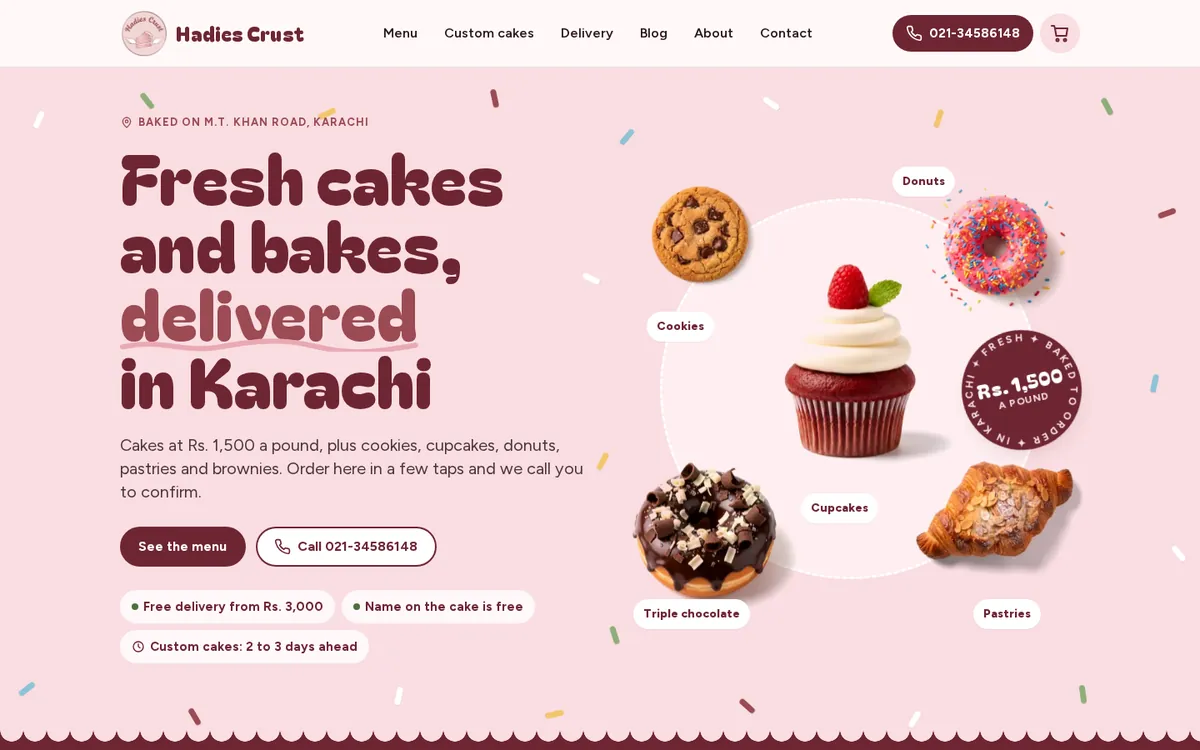
Someone in your office will add products, change prices, see orders, print challans and answer "where is my order". The admin can be the platform's standard one, or built for your workflow with roles for the packer, the accountant and the owner. The RAAH Fits store has its own admin for products, orders and customers; the Hadie's Crust site is a bakery website with its menu and online orders sent by email, which suits a short menu.
Languages
An Urdu version is a second set of every product description, not a toggle. Add it when you know your customers want it.
What adds cost and what does not
| Adds to the quote | Does not, or barely |
|---|---|
| Custom design around your products | A good ready theme with your branding |
| A long product list with variants, entered by the developer | A short catalogue you enter yourself from a clean sheet |
| Card gateway, wallets and bank transfer confirmation | Cash on delivery and WhatsApp order confirmation |
| Courier booking, labels and COD reconciliation in the admin | Orders emailed to the office and booked by hand |
| Live stock sync with a POS or shop | One stock figure kept in the store's own admin |
| An admin built for your packing, accounts and returns workflow | The platform's standard admin |
| A second language | English only, with Urdu added later |
| Product photography and copywriting | Photographs and descriptions you supply, consistent and complete |
| Discount engines, loyalty points, gift cards, size guides | Simple coupon codes |
How to keep the first version small
- Launch with cash on delivery and manual courier booking; add the gateway and the courier integration when orders justify them.
- Start with the products that sell, not the whole range, and enter them yourself from a clean sheet.
- Use a ready theme and spend the design money on photographs.
- Keep English only unless your customers already write to you in Urdu.
- Add stock sync with the shop as the second phase, once online orders are regular.
The store that goes live this way is small but complete: it takes orders, collects COD and tells you what sold. Everything in the "adds to the quote" column can be added later without starting again, provided the platform is chosen with that in mind; our comparison of Shopify, WooCommerce and a custom store covers that choice.
What to ask for in a quote
- The platform, and who owns the accounts (domain, hosting, gateway, store) at the end.
- The number of products included, and who enters them.
- Which payment methods are included and which are extra.
- Whether courier booking and COD reconciliation are included.
- What the admin does, with a list of its screens.
- What happens after launch: hosting, updates and support, as a separate yearly line.
- Payment milestones tied to things you can see.
Ask every company for the same list and the three quotes finally become comparable. Our web development service in Pakistan quotes this way, with every screen shown before it is built. Book a demo and bring your product list; we will tell you which pieces you need now and which can wait.
Questions people ask
How much does an ecommerce website cost in Pakistan?
It depends on the pieces: design, product count, payment methods, courier and COD handling, stock sync and the admin. Operix publishes starting prices and gives a written quote after a short call that lists exactly which pieces are included, so two quotes can be compared line by line.
Is cash on delivery enough to launch with?
For most first stores in Pakistan, yes. COD needs no gateway approval and is how most customers prefer to pay. Add a card gateway when customers ask for it, or when COD refusals become a cost worth reducing.
Who enters the products?
Whoever the quote says. Entering a long list with sizes, colours and photographs is days of work, so agree it in writing. The cheapest path is a clean spreadsheet from you with one row per variant and image files named to match.
Do I need stock sync with my shop from day one?
No, if online orders are few and someone checks the shelf before confirming. Once orders are daily and the same item sells at the counter and online, one stock figure becomes necessary, and it is the piece most often missing from a cheap quote.
Why is the cheapest quote usually not the cheapest store?
Because the pieces it leaves out are added later at a higher price, or the platform cannot take them at all and the store is rebuilt. Ask what is excluded and what the second year costs before choosing on the first figure.