
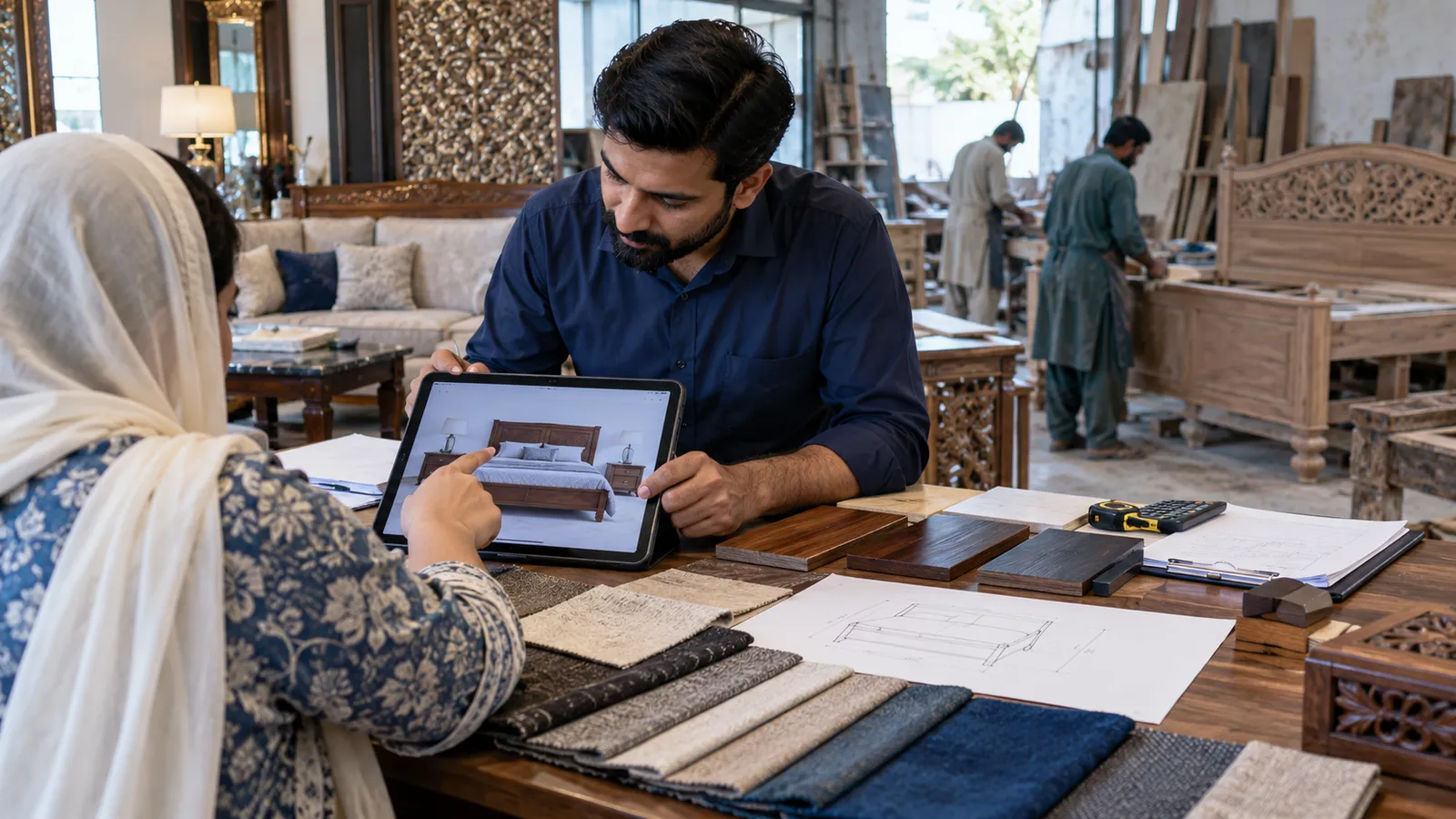
Furniture in Pakistan is usually sold in one place and made in another. A showroom on Karachi's Shahrah-e-Faisal or in Lahore's furniture markets takes the order, the customer picks a design from a catalogue or a photo on their phone, and the job goes to a workshop in Korangi, Gujrat or Chiniot. The order slip says sheesham, a size, a polish colour and a fabric. Somewhere between the slip and the delivery truck, an advance gets forgotten, a size changes, or a karigar is paid twice for the same set.
Showroom and workshop on one record
The software starts with the order: customer, design, size, wood or board type, polish, fabric, quantity, promised date, advance received and balance due. The showroom sees where the order is; the workshop sees what to make; accounts sees the money. When the customer calls asking when their bed will arrive, the salesman looks at the stage instead of phoning the workshop.
Stages of a custom order
| Stage | Who updates it | What is recorded |
|---|---|---|
| Order booked | Showroom | Design, size, wood, polish, fabric, advance, promised date |
| Material issued | Workshop store | Wood in cubic feet, board sheets, hardware |
| Carpentry | Mistri or supervisor | Frame done, karigar name, rate |
| Polish or paint | Polish karigar | Coats, colour, karigar name, rate |
| Upholstery | Upholstery karigar | Fabric used, foam, karigar name, rate |
| Ready and delivered | Showroom or delivery staff | Delivery date, balance collected, fitting done |
Wood and board stock
Solid wood such as sheesham, kikar and deodar is bought in logs or planks and measured in cubic feet; board, MDF and ply come in sheets by thickness. A lot of value walks out of a workshop as offcuts and unrecorded planks. The software holds wood by type and cubic feet and boards by sheet size, and issues them against an order number. At the end of the month you can compare what the orders should have needed with what was issued. For general stock control, see inventory management software.
Karigar hisaab by stage
Carpenters, polish karigars and upholsterers are often paid per piece or per set, with rates that differ by design. When a stage is marked done against an order with the karigar's name, the system adds that rate to his account. Advances taken during the week are deducted, and on payday a slip prints in Urdu. Work that comes back for repair can be held from payment until it is fixed. If the same karigar also works on orders from your second showroom, his account still shows it all in one place.
- Rate cards per design and stage, so the same work is paid the same way.
- Weekly advances recorded the day they are given.
- Repair and rework flagged against the original karigar.
- One statement per karigar across all orders and showrooms.
Ready stock, wedding season and the showroom
Wedding season brings bridal furniture sets with fixed dates, and nobody forgives a late dressing table. The software lists orders by promised date so the workshop sees what is at risk. Ready stock on the showroom floor is sold through a simple counter screen with barcode or item code. If you sell several brands or run more than one showroom, our guide to multi-branch business software explains how stock and cash stay separate per branch. A small POS for the showroom counter can sit on the same data.
Photograph your designs
Build a catalogue of your designs with codes, sizes and standard wood and board needs.
Write the rate card
List what each karigar stage pays for each design, as you pay it today.
Enter open orders
Load every order not yet delivered, with advance and balance, before the switch.
Mark stages from the workshop
Give the supervisor a phone to mark stages done with the karigar's name.
Pay one week from the system
Run one payday from the system's karigar statements and check it against the old register.
Delivery is the last place money leaks. The balance due should print on the delivery challan, the delivery staff should mark it collected or pending, and any fitting or assembly at the customer's home should be logged. Complaints after delivery, such as a loose hinge or a polish mark, are recorded against the order and the karigar who did the work.
How Operix can help
Operix builds ERP software for Pakistan from Old Clifton, Karachi, with on-site work in Karachi and online projects for Lahore, Gujrat and Chiniot. For the factory view see our manufacturing industry page. If you work leather into sofas or bags, see leather goods ERP. To map your order slip into the system, contact us.
Questions people ask
Can customers see their order status?
Yes, if you want it. A simple link or a WhatsApp update can show the stage, without giving access to anything else.
Can it hold wood in cubic feet?
Yes. Solid wood is held by type in cubic feet, board and ply by sheet size and thickness, and both are issued to orders.
Do small workshops need this?
A workshop with a few karigars and one showroom can run on a good register. Software helps once orders overlap, advances pile up, and karigar accounts get hard to settle.
Do you have an office in Lahore or Chiniot?
No. Operix works from Karachi, with on-site visits there. Other cities are served online, with visits when a project needs them.