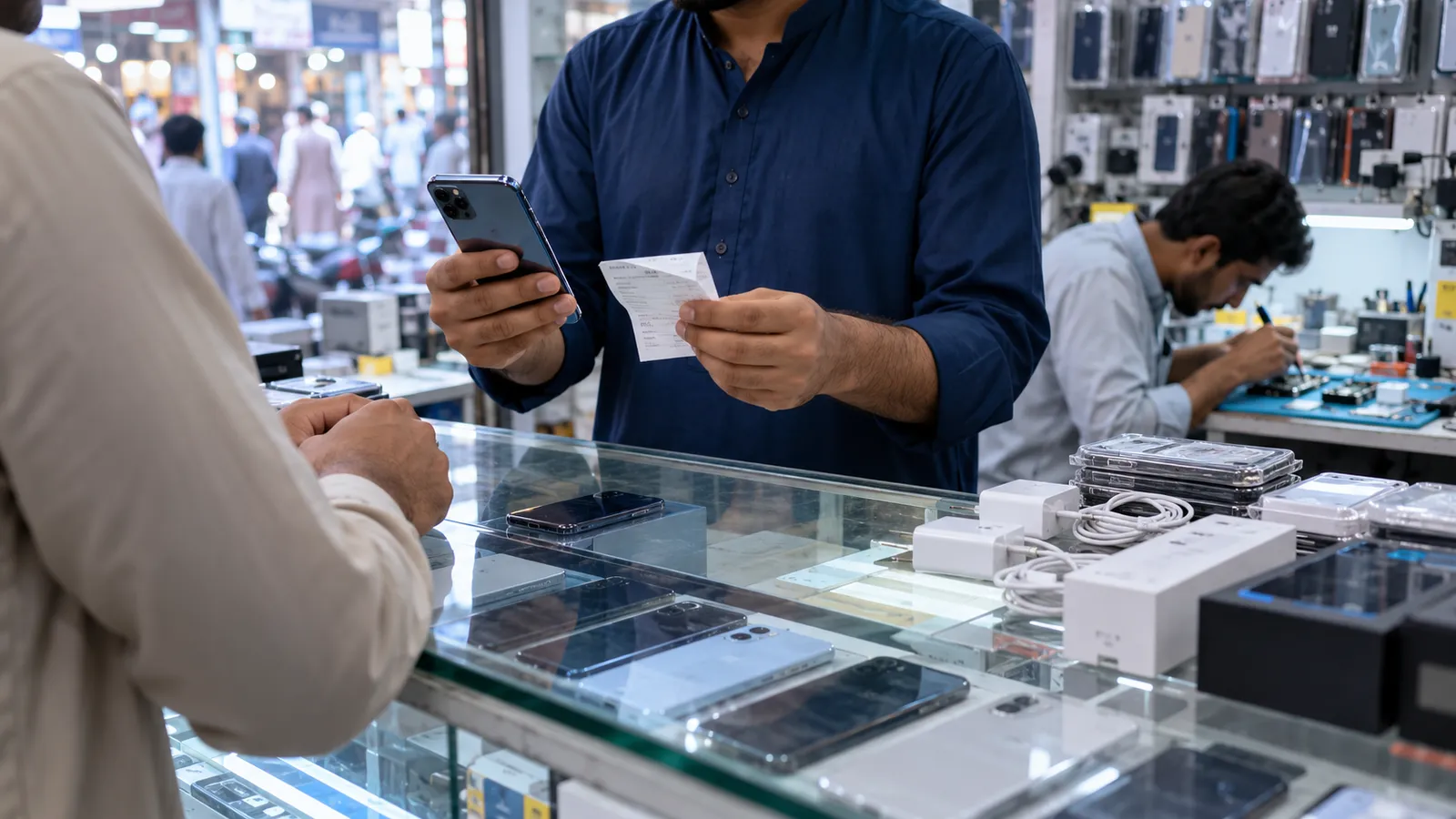
In Saddar's mobile market or Hall Road, a mobile shop is three businesses in one counter: new phones, a repair bench behind the glass, and a steady trade in used sets. A customer walks in with a phone that died in a week, holding a bill with no IMEI on it. Another wants to sell his old phone for cash. Without a proper record, every one of these turns into an argument.
Phones by IMEI, accessories by quantity
A phone is not just 'one unit of model X'. It is one IMEI, bought from one supplier on one date at one cost. Scan the IMEI when stock arrives and again when it sells, and the bill carries the number. Later, any question about that set is answered by typing the IMEI. Accessories such as covers, chargers, cables, earphones and screen protectors are different: they are counted by quantity and sold off the shelf, so they stay as normal stock lines.
| Trade | Key record | What can go wrong without it |
|---|---|---|
| New phones | IMEI, supplier, cost, sale bill | Wrong set claimed under warranty, or stock that cannot be matched |
| Repairs | Job token, fault, parts, status, phone number | Lost sets, disputes over what was fixed |
| Used phones | Seller's CNIC copy, IMEI, condition, price paid | Buying a stolen set with no record |
| Accessories | Item and quantity | Silent shrinkage on small items |
Warranty without the bill book
Phones come with company warranty, shop warranty or none, depending on how they were sourced. Record the warranty type and period at sale. When a customer returns, search by IMEI and the screen shows the sale date, the warranty and whether it is still valid. If you send a set to a service centre, log when it left and when it came back.
The repair bench
- Book the job: customer name and phone, model, IMEI, fault described by the customer, and anything left with the set such as a cover or SIM.
- Print a token for the customer and stick a matching slip on the phone.
- The technician adds the diagnosis, parts used and the quoted charge.
- The customer is told the charge, ideally by WhatsApp, and agrees before work starts.
- On collection, the token is scanned, the bill printed and parts taken out of stock.
Parts such as screens, batteries and charging ports are stock like anything else. When they are used on a job, they should leave stock automatically, so you know what you are actually spending on repairs.
Buying used phones
Check the IMEI
Dial *#06# and match the number to the box and the phone settings.
Record the seller
Take a copy of the seller's CNIC and a phone number, and save it against the purchase.
Grade the condition
Note screen, body, battery health and any faults, with a photo.
Agree and pay
Record the price paid and how: cash, bank transfer or wallet.
Add to stock
The set enters used stock with its IMEI and cost, ready to price and sell.
Keeping this record protects you if a set later turns out to be stolen or blocked. The software cannot check whether a phone is stolen, but it shows you did your part.
Payments and instalments
Phone buyers pay by cash, card, bank transfer, JazzCash or EasyPaisa, and some shops sell on instalments to known customers. If you do, each instalment sale needs a schedule and a list of who is due this week, which is the same udhaar problem every shop has. Our kiryana store software guide shows how a simple credit ledger works.
If you supply other shops wholesale from a market like Saddar, your side looks more like distribution software, with dealer balances and salesmen.
Daily closing on a mobile counter
Phones are high value, so closing should be strict. At the end of the day, the system lists every IMEI that should be on the shelf, and staff check the boxes against that list. Cash, card and wallet totals are matched against the bills, and any phone given out for checking, to a customer or to the repair bench, shows as out until it returns. A five-minute check each evening is far cheaper than finding a missing set at month end.
If you run two counters in the same market, or a shop plus a repair unit upstairs, keep them in one system with separate locations. A set moved from the shop to the repair bench, or from one counter to another, is a transfer with the IMEI, not a verbal handover. It is a small habit that removes most of the 'who has it?' conversations.
Operix builds POS systems in Pakistan for retail shops, with on-site setup in Karachi. Book a demo and bring one repair token and one bill so we can map your counter.
Questions people ask
Can the bill show the IMEI number?
Yes. The IMEI is scanned at sale and printed on the bill, and the sale can be found later by typing the IMEI.
Can the software manage repair jobs?
Yes. Each job gets a token, a status, parts used and the charge, and the customer can be updated on WhatsApp.
Can it check if a used phone is stolen?
No. The software records the IMEI, the seller's details and the condition so you have a clear record, but checking a phone's status is done outside the system.
How much does mobile shop software cost?
It depends on whether you need repairs, used phones, branches or wholesale. Operix does not publish prices; you get a written quote after a discovery call.