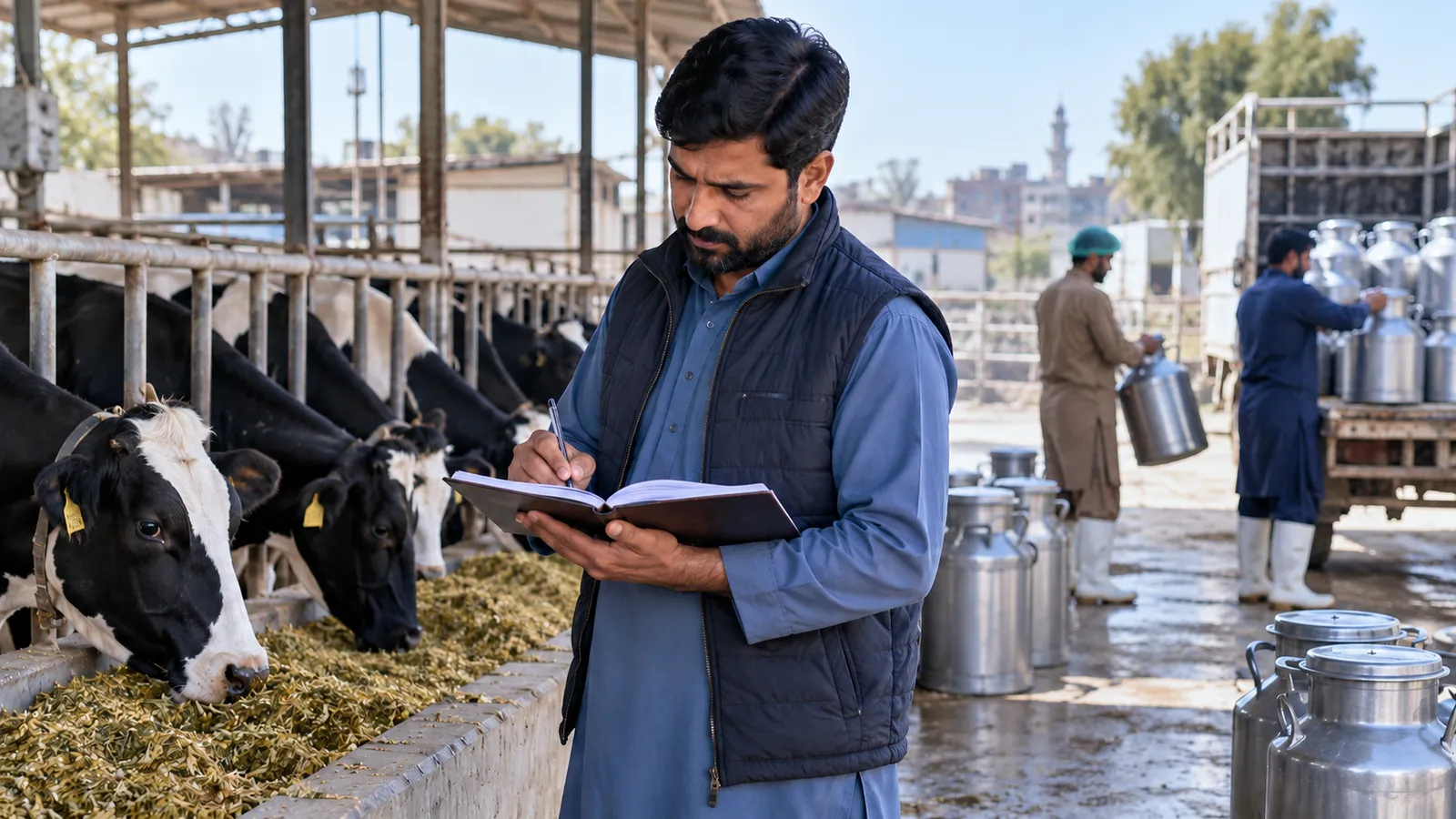
On a dairy farm near Karachi's cattle colonies or on the edge of Lahore, the owner knows roughly how much milk went out today. What he rarely knows is which animals are paying for their feed, and which are eating the profit. On a poultry farm the question is similar: how much feed did this flock eat for the eggs or weight it gave, and how many birds were lost? A register in the shed answers some of it. A system that adds it up answers the rest.
Animals for dairy, flocks for poultry
The two trades share a lot but count differently. A dairy farm keeps one record per animal: tag, breed, date of purchase or birth, calving, milking status, health. A poultry farm keeps one record per flock or shed: date placed, number of birds, breed, age, mortality. Good farm software lets you pick the model that fits, or both if you run both.
| What you track | Dairy farm | Poultry farm |
|---|---|---|
| Main record | Each animal by tag | Each flock by shed and date placed |
| Daily yield | Milk per animal or per milking | Eggs per flock, or weight for broilers |
| Feed | Fodder, silage, concentrate per group | Feed bags per shed |
| Health | Vaccines, treatments, vet visits | Vaccination schedule, medicine in water |
| Losses | Deaths, culls, dry period | Daily mortality per shed |
| Sales | Milk to collectors, shops, homes; animals sold | Eggs or birds to traders |
Daily entries: feed, yield and mortality
Everything useful comes from three daily numbers: what was fed, what was produced and what was lost. These are best entered in the shed on a phone, at the time, by the person who did the work. A simple screen with large buttons in Urdu works better than any register copied up at night. If the signal is weak, the entries wait on the phone and send later.
Feed stock
Feed bought goes into stock; feed issued comes out against a group of animals or a shed. Monthly, the stock on the system is checked against the bags in the store. This one control catches more leakage than anything else on a farm. Our inventory management software guide covers stock counts.
List what you have
Tag and enter every animal, or enter every flock with its shed, date placed and bird count.
Set up feed items
Enter each feed type with its unit, and your current stock in the store.
Train one person per shed
Show them the phone screen for feed, yield and mortality, in Urdu, and have them enter for a week while you check.
Enter sales and payments
Record milk, egg and bird sales against each buyer, with credit where it applies.
Review the first month
Look at yield and feed per animal or flock, and fix any entries that look wrong before trusting the reports.
Health, vaccines and the vet
Vaccination schedules for flocks and treatments for animals should be in the system, with reminders when a dose is due. Medicine is stock too, issued against an animal or shed. When a vet visits, the notes go on the record. Over time you see which animals or sheds need the most treatment, and which suppliers' birds do best.
Sales on credit
Milk goes to collectors, dairy shops and households, often on a monthly account. Eggs and birds go to traders, many on credit. Each buyer needs a ledger with daily deliveries and payments by cash, bank transfer, JazzCash or EasyPaisa. A monthly statement on WhatsApp ends most arguments about litres delivered.
A small farm with a handful of animals may be better served by a notebook and a simple spreadsheet. Software earns its place when there are enough animals, sheds or buyers that nobody can hold the numbers in their head.
Cost per litre and per egg
Once feed, medicine, labour and other costs are entered against groups or sheds, the system can show cost per litre or per egg for a month. It will not be exact, and it does not need to be. It needs to be close enough to show whether a group of animals or a flock is worth keeping. Farms that sell to processors or run their own milk shop may later want links to a POS system for the counter.
Related reading and next step
Farms that also deal in feed and inputs should see agri input dealer software. If milk or eggs go into cold storage, cold storage software explains party-wise lots. Operix Systems builds ERP software in Pakistan from Old Clifton, Karachi, and our manufacturing industry page shows how we handle production records. To talk about your farm, contact us.
Questions people ask
Can farm workers enter data in Urdu?
Yes. The shed screens can be in Urdu with large buttons and few fields. Owners and accounts can use English screens on the same system.
Does it work without internet on the farm?
Entries can be saved on the phone and sent when a signal is available. Many farms have weak coverage, so we plan for it from the start.
Can one system run both a dairy and a poultry farm?
Yes. Animals and flocks are kept as separate records, while feed stock, buyers and accounts are shared.
Do you visit farms outside Karachi?
Operix works from Old Clifton, Karachi. Farms around Karachi can get on-site setup; farms elsewhere are served online, with visits when the project needs them.