
"We want to build a Daraz for furniture", or for auto parts, wedding services, handicrafts or farm produce. The idea is sound in a category where buyers struggle to find sellers. The software is the smaller part of it. These are the questions to settle before a multivendor website is built.
What makes a multivendor website different from a normal online store?
- Vendors upload and manage their own products, prices and stock, within rules you set.
- A customer's cart can hold items from several vendors, so one order is split into a sub-order per vendor.
- Each vendor sees only its own orders; the marketplace sees all of them.
- Commission is deducted from each sale, and vendors are paid by statement, not per order.
- Vendors need their own dashboard, and the owner needs tools to approve, suspend and audit them.
- Disputes sit between three parties: the customer, the vendor and you.
Single-vendor store or multivendor marketplace?
| Single-vendor store | Multivendor marketplace | |
|---|---|---|
| Catalogue | Your products, your photos, one standard | Many sellers' products; quality has to be policed |
| Orders | One order, one dispatch | Split by vendor, each dispatched and tracked separately |
| Payments | Money comes to you | Money comes to you, then goes out to vendors less commission |
| Support | You answer for your own stock | You answer to the customer for every vendor |
| Suits | A brand, shop or importer with its own stock | A category with many small sellers and buyers who cannot find them |
What does the marketplace owner have to run?
- Vendor onboarding: checking the business, agreeing commission and return terms, and approving the first products.
- Catalogue quality: titles, photos and categories that make the site look like one shop rather than a bazaar of mismatched listings.
- Delivery: deciding whether vendors ship themselves or you book the courier, and who pays for returns.
- Customer service: the buyer calls you, not the vendor, when a parcel is late.
- Refunds and disputes: a written policy and a named person who decides.
- Vendor payouts: a statement each period that vendors can check line by line.
Each item is a person's job before it is a feature. Write them down first; how to write a software requirements document shows the format.
What does a vendor dashboard need?
- Add and edit products with variants, photos and stock, from a phone.
- New orders with a WhatsApp or sound alert, and buttons to accept, pack and mark dispatched with a tracking number.
- A statement of sales, commission, returns and the balance due, by period.
- Returns and disputes, with the customer's reason and the marketplace's decision.
- Performance: late dispatches, cancellations and ratings, so a vendor can see why it ranks where it does.
How do commission and payouts work?
The marketplace collects the money, whether as cash on delivery through the courier or online through a gateway in the marketplace's name. Each period, the system totals every vendor's delivered orders, deducts commission and agreed charges, subtracts returns, and produces a statement. The vendor is paid the balance by bank transfer and can open the statement to see every order behind it. The rate and the period are business decisions written into the vendor agreement; the software only applies them. Cash on delivery adds a lag, because the courier pays you before you can pay the vendor, so the statement should show which orders are still waiting on courier settlement.
Should I start as a single-vendor store and add vendors later?
Usually, yes. Marketplaces rarely fail because the software lacked a feature; they fail because sellers listed products and nobody came to buy. A single store, or a store with a handful of vendors you manage by hand, lets you find buyers and learn the category. Build the data with vendors in mind from the start, so every product and order already carries a vendor, and add vendor sign-up, commission and payouts when sellers are asking to join. Whether to sell on an existing marketplace first is weighed in Daraz or your own online store.
Marketplace plugin or custom build?
WooCommerce has multivendor plugins, and they are a fair way to test an idea with a few vendors, as long as someone keeps the plugins updated and you accept their screens as they are. A custom build makes sense when the order split, the payout rules or the vendor dashboard must follow your own agreement, or when the marketplace must connect to a courier or an ERP. The buyer app, seller app and operations side are described in building an ecommerce app like Daraz; what any store needs underneath is in online store development in Pakistan.
What has Operix built that is close to a marketplace?
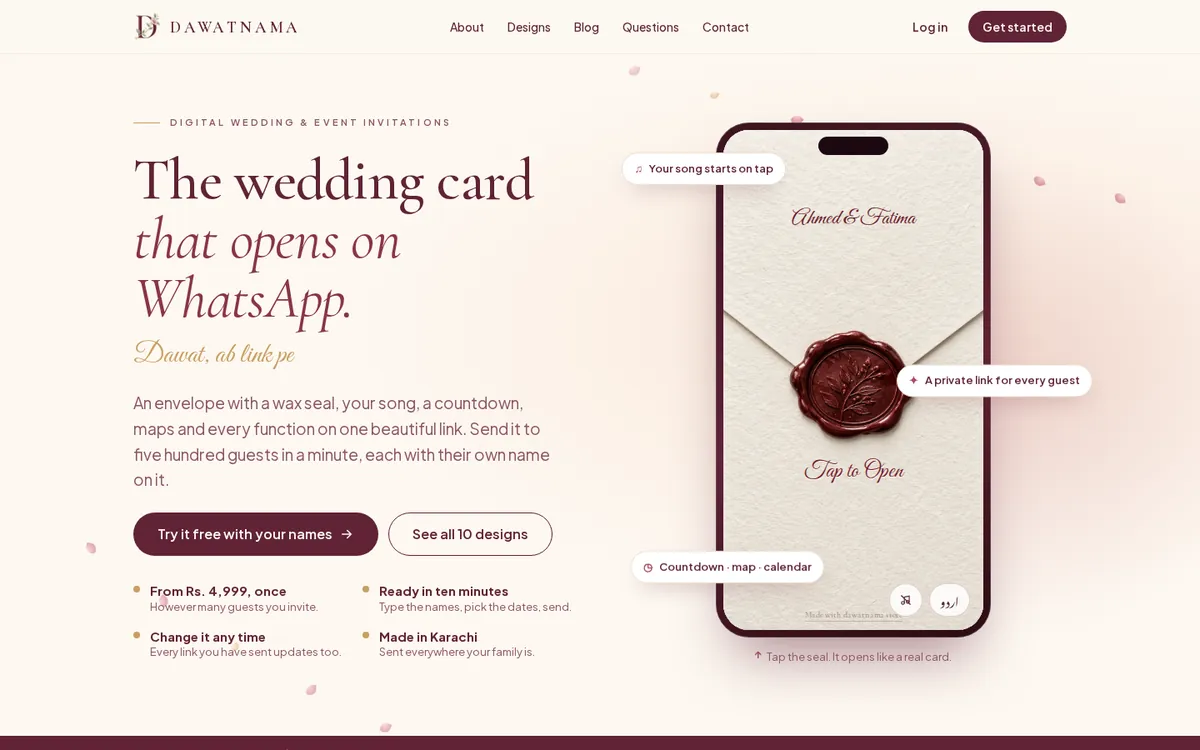
Dawatnama is a platform for digital wedding and event invitations: customers design a card, add guests and send each one a personal link, with a customer panel on one side and an admin panel for orders and cards on the other. It is the two-sided structure a marketplace needs, without the vendor side. Our web development team designs every screen, including the vendor dashboard, before it is built, and our web design agency in Karachi page explains how a project runs. Book a free demo and tell us the category; we will say honestly whether a marketplace is the right first step.
Questions people ask
Can each vendor have its own storefront page?
Yes. A page per vendor with its products, ratings and policies is standard, and it gives vendors a link to share with their own customers.
Who books the courier in a marketplace?
Either side can. Vendors shipping themselves is simpler to build; the marketplace booking the courier gives you control over delivery and cash on delivery settlement. Decide before the build.
Can we charge a listing fee instead of commission?
Yes, or both. The software applies whatever the vendor agreement says: a fee per listing, a commission per sale, or a monthly subscription.
How many vendors do we need to start?
Enough to cover what a buyer expects to find in the category, and few enough that you can speak to each one personally. Quality of vendors matters more than the count.
Does a marketplace need a mobile app?
A fast website first, for buyers and vendors. Add apps once there are repeat buyers and vendors who want order alerts on their phones.