
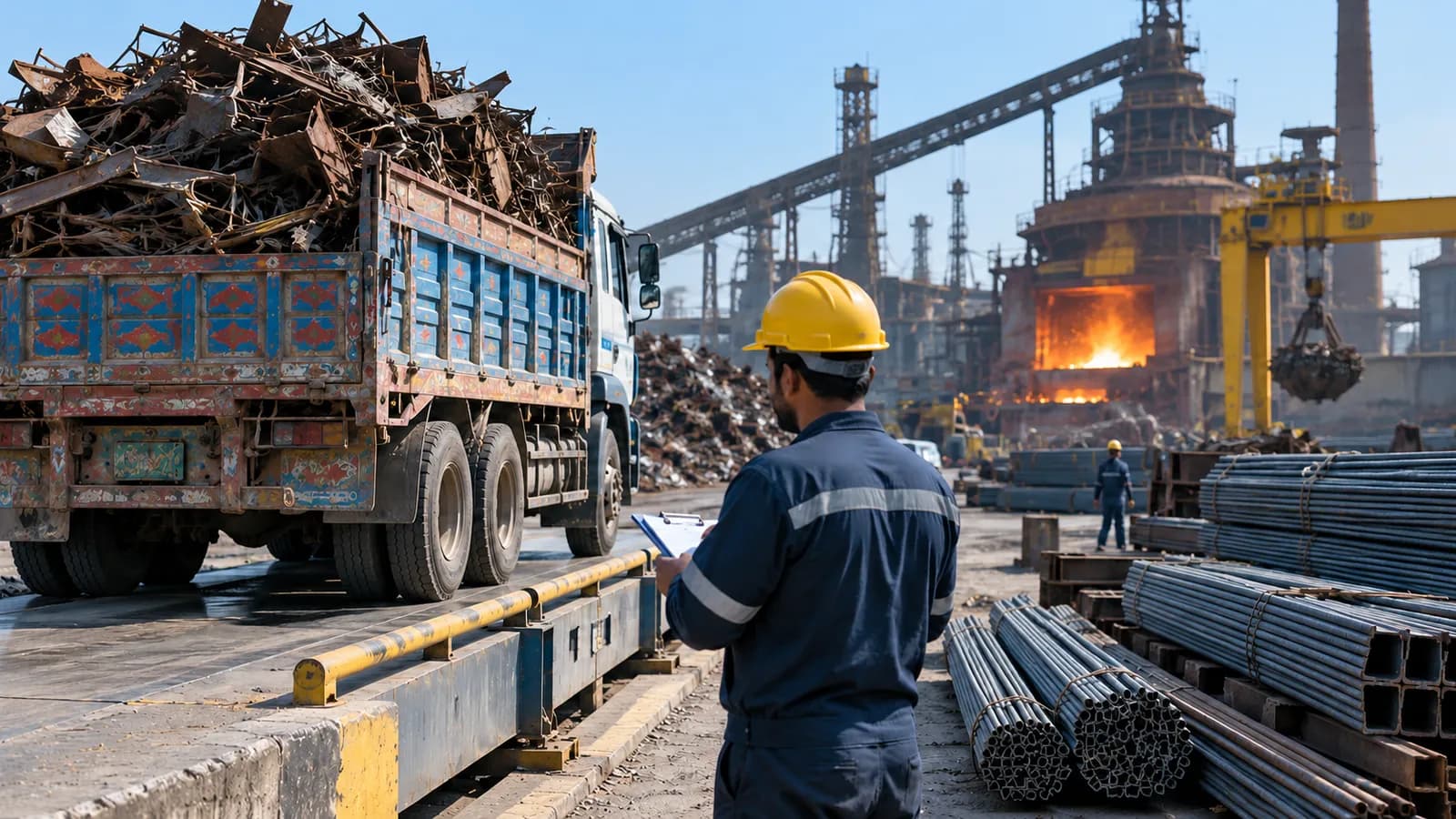
Re-rolling mills in Lahore and Gujranwala, furnaces and foundries along Karachi's industrial belts, and the engineering workshops of Daska, Gujranwala and Karachi's SITE all deal in weight. Scrap comes in by truck and goes over the kanta, billets are melted or bought, bars and girders go out by the tonne. A small difference in weight per heat or per shift is the difference between profit and loss, and it usually lives in a register nobody reconciles.
Two different businesses under one roof
A mill makes standard products for stock and sells by weight at a daily rate. A workshop makes to order: a gate, a structure, a machined part, a repair. Many groups do both. The ERP should treat them differently: process tracking by weight for the mill, job orders for the workshop. If you run a broader factory, our guide to ERP for Gujranwala manufacturers covers that city's mix in more detail.
Scrap to billet to bar
- Scrap is weighed in at the weighbridge, graded by type, and recorded against the supplier with any deductions.
- A heat in the furnace records scrap and additives charged, billets or ingots produced, and the loss.
- Billets, bought or made, are issued to the rolling mill by weight and count.
- Rolling records bars or sections produced by size, with miss-rolls, end cuts and mill scale.
- Finished stock is held by size and weight, and sold by weight with a weighbridge slip.
Each step has an expected loss. The ERP compares the actual with the standard per heat and per shift, and shows the trend. End cuts and miss-rolls go back as scrap with a value, not as zero.
What a workshop job order holds
| Section | Contents |
|---|---|
| Customer and drawing | Customer, drawing or sample reference, quantity, due date |
| Estimate | Material by weight and section, consumables, machine hours, labour, outside work |
| Material issue | Plates, pipes, sections and bars issued against the job by weight |
| Machine and labour | Hours per machine (lathe, CNC, welding, cutting) and per worker or team |
| Outside work | Galvanising, painting, heat treatment sent out, with gate passes |
| Close | Actual cost against estimate, delivery challan and invoice |
The weighbridge and the daily rate
Most disputes in steel start at the kanta. If the weighbridge slip number and weight are entered once, at the gate, and every purchase or sale points to that slip, arguments with suppliers and buyers become quicker to settle. Prices in steel move daily, so sales orders should carry the rate agreed that day, and the ERP should show stock value at current and at cost. Sales tax on goods is collected by FBR; how it applies to scrap and finished steel in your case is something to confirm with your tax adviser.
Do not forget the yard. Scrap sits outside in heaps by grade, and a monthly yard count by estimate is better than none. Electricity and gas are a large share of melting cost, so recording units used per heat, from the meter, lets you compare heats fairly. Machine breakdowns and furnace relining stop production for days; logging them against the shift helps explain a bad week instead of leaving it as a mystery in the loss report. Workshops should also log rework, because a weld redone is labour paid twice.
Credit, dealers and recoveries
Steel is often sold to dealers and contractors on credit. The ERP's sales side should hold credit limits, ageing and post-dated cheques, and let a salesman see a dealer's balance before promising more. For dealer networks and field booking, our distribution software guide goes further.
Set standard losses
Agree with the mill manager the normal loss for melting and for each rolling size.
Link every movement to a slip
Make the weighbridge slip number compulsory on every receipt and dispatch.
Record per heat and per shift
Enter charge and output weights for every heat and every rolling shift on the same day.
Book scrap returns
Weigh and enter end cuts, miss-rolls and scale returned to the yard.
Review the loss report each week
Compare actual with standard by shift and talk to the shift in charge about the gaps.
Working with Operix
Operix builds ERP software for Pakistan from Old Clifton, Karachi. Karachi mills and workshops get on-site discovery and training; Lahore and Gujranwala units are served online, with visits when needed. See our manufacturing industry page and manufacturing ERP in Pakistan, and if you also make furniture or fittings, our furniture manufacturing guide. Bring a week of heat and rolling registers to a demo.
Questions people ask
Can the ERP read weights directly from the weighbridge?
Often yes, if the weighbridge indicator has a data output. If not, the operator enters the slip once at the gate and every document uses that entry.
Can it hold stock in tonnes and pieces?
Yes. Billets and bars are held by weight with a piece count beside it, and sizes carry a standard weight per length for checks.
Is it useful for a small workshop?
A small workshop with a few jobs a month may manage with a job book. Once you run many jobs, machines and outside processes at once, job order costing starts to show where money is lost.
Do you have an office in Gujranwala?
No. Operix works from Karachi. Gujranwala and Lahore clients are served online, with visits when the project needs them.
How much does a steel ERP cost?
It depends on the sites, modules, users and integrations such as weighbridges. Operix does not publish prices; you get a written quote after discovery.