You have an English website that works. Now a government department, a local partner or your own customers ask for Arabic, and the first quote you receive says "we will translate the pages". Translation is the smallest part of the job. A bilingual site for a UAE audience has to be laid out from the other side, read from the other side, found by Google in both languages and answered in both. Here is what to get right, in the order it usually goes wrong.
Right to left is a layout, not a setting
Arabic is read from right to left, so the whole page mirrors. The logo moves to the right, the menu runs from right to left, the "next" arrow points left and a sidebar swaps sides. Anything a developer hard-coded as "left" sits on the wrong side of the Arabic page. Browsers handle most of this when the page declares its direction and the stylesheet uses start and end instead of left and right; older themes and page builders usually do not, and the Arabic version ends up as an English layout with Arabic text poured into it.
Some things do not mirror. Numbers, phone numbers, times, email addresses and product codes stay left to right inside Arabic text, and a form field for a mobile number must not flip its digits. Icons that mean direction (back, forward, play) mirror; icons that are pictures (a phone, a lorry, a tick) do not. Agree the list before design starts, not after the Arabic page is built.
Arabic typography needs more room
Arabic letters join and carry marks above and below the line. Set in an English line height, the text looks cramped and the marks collide with the line above. The Arabic page needs its own font chosen for screens, a slightly larger size, more line height and often more vertical space inside buttons and headings. Heavy bold weights that look fine in English make Arabic hard to read, so body text stays light. This is UI/UX design work, not a find-and-replace: put the same paragraph in both languages side by side on a phone and ask a native reader which one tires them first.
Translated copy and transcreated copy
A translator turns the English page into correct Arabic. That is enough for terms and conditions, a privacy page and a specification table. It is not enough for the home page, the service pages or any call to action. Those are rewritten in Arabic by someone who sells, so the tone suits the market and the words are the ones an Arabic-speaking customer actually types into Google. The two versions do not need to match sentence by sentence; they need to make the same offer. Machine translation is useful for a first draft of the long legal pages and for nothing a customer reads first.
One address per language, with hreflang
Each language page has its own URL (for example /en/services and /ar/services), its own title and description, and a hreflang tag that tells Google which Arabic page is the twin of which English page. A button that swaps the text on the same address hides the Arabic site from search entirely. The search side is covered in our guide to bilingual SEO in Dubai. The design side is that the language switch is visible on every page, labelled in the target language (عربي on the English page, English on the Arabic page), and keeps the visitor on the same page rather than sending them back to the home page.
Forms, WhatsApp and replies in both languages
An Arabic page with an English-only form is a dead end. Labels, placeholders, error messages, the thank-you message and the confirmation email all need an Arabic version. The WhatsApp button should open with a greeting in the language of the page the visitor was reading, and the person who answers should be able to reply in it. If the office cannot answer in Arabic, say so on the page and offer a form instead; a slow reply in the wrong language costs more than no Arabic page at all.
Which language comes first for a UAE audience
Build first for the language your paying customers use, and make the second complete rather than a shadow. For many Dubai businesses that is English for day-to-day trade, with Arabic for government bodies, local family groups and Arabic-speaking consumers. For a business selling to households in Sharjah, Al Ain or Abu Dhabi, Arabic may be the version that earns the enquiries. Look at your past enquiries and your WhatsApp chats before deciding. If you do not know yet, launch one language properly and add the second within the same project, not a year later.
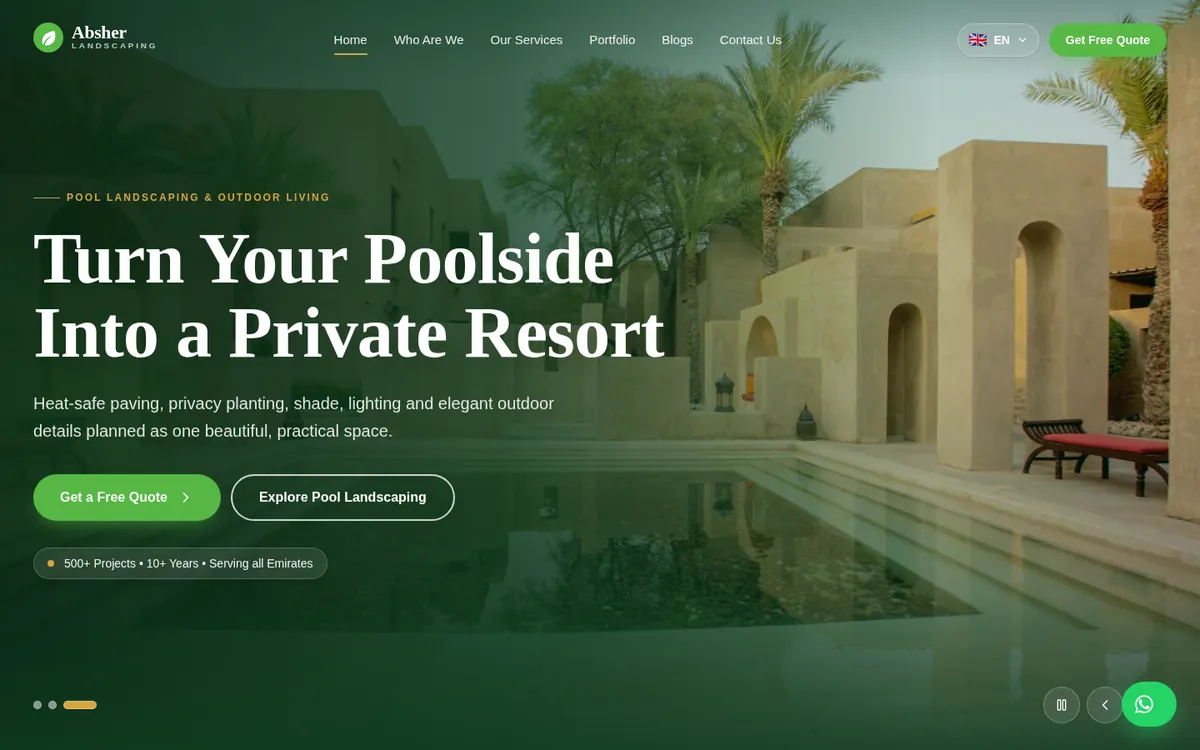
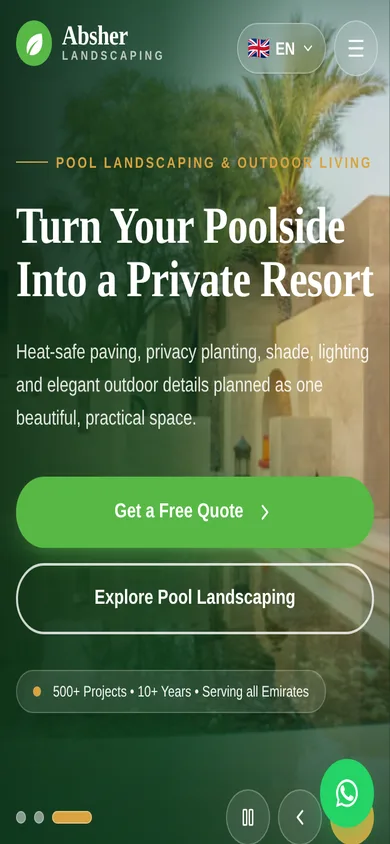
The Absher Landscaping website is the full version of this job: one site for a UAE landscaping company in English, Arabic, Chinese and Russian, each language a complete site rather than a translated copy of the English one.
A bilingual website checklist
| Area | What to check |
|---|---|
| Direction | Page declares right to left; menu, breadcrumbs and arrows mirror; sidebars swap sides |
| Numbers and codes | Phone numbers, dates, times and part numbers stay left to right |
| Icons | Directional icons mirror; pictorial icons do not |
| Fonts | A screen Arabic font, larger line height, lighter weight for body text |
| Copy | Sales pages rewritten by a native speaker; legal pages translated |
| URLs | A separate address per language, hreflang pairs, Arabic titles and descriptions |
| Language switch | On every page, labelled in the target language, stays on the same page |
| Forms | Labels, errors, thank-you message and emails in Arabic; the mobile number field keeps its digits |
| Greeting in the page's language, and someone who can reply in it | |
| Images | Text inside images translated or removed; photographs not mirrored |
Add this table to the general website launch checklist and the Arabic version goes live in the same state as the English one. Our web development service for Dubai and the UAE builds bilingual sites from Karachi, with every page shown in both languages before it is built. Book a call with a link to your current site and we will tell you which of these it already gets right.
Questions people ask
Can I just translate my English website into Arabic?
Translation covers the words, not the page. The Arabic version also needs a mirrored right-to-left layout, its own font settings, its own URL for search, and forms and replies in Arabic. Translated sales pages usually read as foreign, so have them rewritten by a native speaker.
Should the Arabic or the English version come first?
Start with the language your paying customers use, which for many Dubai businesses is English, and build the Arabic version as a complete site rather than a partial copy. If your enquiries come mostly from Arabic-speaking households or government bodies, start with Arabic.
Do I need a separate domain for the Arabic site?
No. A language folder on the same domain, such as /ar/, is enough as long as each page has its own address and a hreflang tag pointing to its twin. A separate domain splits your search standing in two and doubles the hosting and upkeep.
Can a WordPress site be made bilingual?
Yes, with a multilingual plugin, provided the theme supports right-to-left layouts. Many themes do not, and the Arabic pages come out with a mirrored menu but English spacing and alignment. Test the theme with real Arabic text before committing to it.
Does Operix build bilingual websites from Karachi?
Yes. Bilingual and multilingual sites for the UAE are designed and built at our Karachi office and delivered online, with every page shown in both languages before it is built. Support runs on one WhatsApp number.