Selling online to American customers depends less on how the storefront looks than on things the shopper never thinks about until one fails: tax, payment, delivery, returns and whether the page works for them at all. Whether you are a US brand opening a first store or an overseas business opening a US one, settle these before anyone designs a home page.
What a US online store has to get right
| Area | What shoppers expect | How the store handles it |
|---|---|---|
| Sales tax | The right tax for their address, shown before they pay | A tax service returns the amount for each order at checkout |
| Payments | Cards, Apple Pay, Google Pay, PayPal, buy now pay later | Your own processor account, with the wallets switched on |
| Shipping | A choice of speed and price, with tracking | Rates and labels from USPS, UPS or FedEx |
| Returns | A stated policy and an easy way to send things back | A returns page, a request form and a label process |
| Accessibility | A store usable with a keyboard and a screen reader | Built into the templates and tested before launch |
| Privacy | To know what is collected, and to be able to say no | Cookie consent and a privacy notice that allow for state rules |
Sales tax: use a tax service
There is no national VAT in the US. Each state sets its own sales tax, and counties and cities often add theirs, so two customers in one state can owe different amounts. For that reason stores do not usually keep the rates themselves. At checkout the store sends the delivery address and the cart to a tax service and shows the figure that comes back. The order records what was charged, and the reports follow from the orders.
Whether you have to collect in a given state at all is a legal question, not a software one. Confirm it with your tax adviser before launch, and tell your developer which states to switch on.
Payments and checkout
US shoppers pay by card, with Apple Pay or Google Pay, through PayPal, and in instalments through buy now pay later providers. Offer the wallets: on a phone they replace typing a card number with a tap. Register the payment account to your company, never to your developer, so that payouts and disputes are yours to manage. Keep the checkout short, allow guest checkout, and show the total with tax and shipping before the final button.
Carriers and returns
USPS, UPS and FedEx are the carriers American shoppers know. A store can fetch live rates from them at checkout or charge flat rates that you set, and it can print labels and send tracking emails. Decide which before the build starts, because live rates need an accurate weight and box size for every product.
Returns deserve the same care. Write the policy in plain words, link it from every product page, and decide who pays for the return label. A clear returns page answers the question before it becomes an email.
Accessibility, privacy and speed
A store that cannot be used with a keyboard or read by a screen reader shuts customers out, and in the US it is also a legal risk businesses take seriously. The fixes are ordinary craft: readable contrast, a label on every form field, descriptions on product images, and a checkout that works without a mouse. They are far easier to build in than to add afterwards.
Privacy rules differ by state, and California has its own law. A store needs a privacy notice that says what it collects and a cookie banner that does what it says; ask your lawyer which rules apply to you. Speed is the third quiet requirement. Shoppers on a phone give up on a sluggish product page before any of the rest matters.
Shopify or a custom store
For most new US stores a hosted platform is the right start. Shopify takes care of hosting and checkout, supports the wallets, and has apps for tax and shipping, so you can begin selling without building any of that. Going custom is justified when the platform works against you: products configured in ways its variants cannot hold, prices that differ by customer or contract, or stock that must come live from your own ERP. The full comparison is in Shopify vs WooCommerce vs a custom store.
Whichever you choose, the store still has to be found. Category and product pages need their own titles and text, and the site structure should be fixed before launch. That work is described under SEO services for US businesses.
Ecommerce website development for the USA, step by step
Settle the tax position
Ask your tax adviser where you must collect, then choose the tax service.
Open the accounts yourself
Domain, platform or hosting, payment processor and carrier accounts, each registered to your company.
Weigh and measure the catalogue
Weight, box size, photos and a description for every product.
Write the policies
Shipping, returns and privacy in plain words, before design starts.
Approve the designs
Home, category, product, cart and checkout, looked at on a phone first.
Place test orders
Order to addresses in different states with each payment method, and send one order back.
Where Operix stands
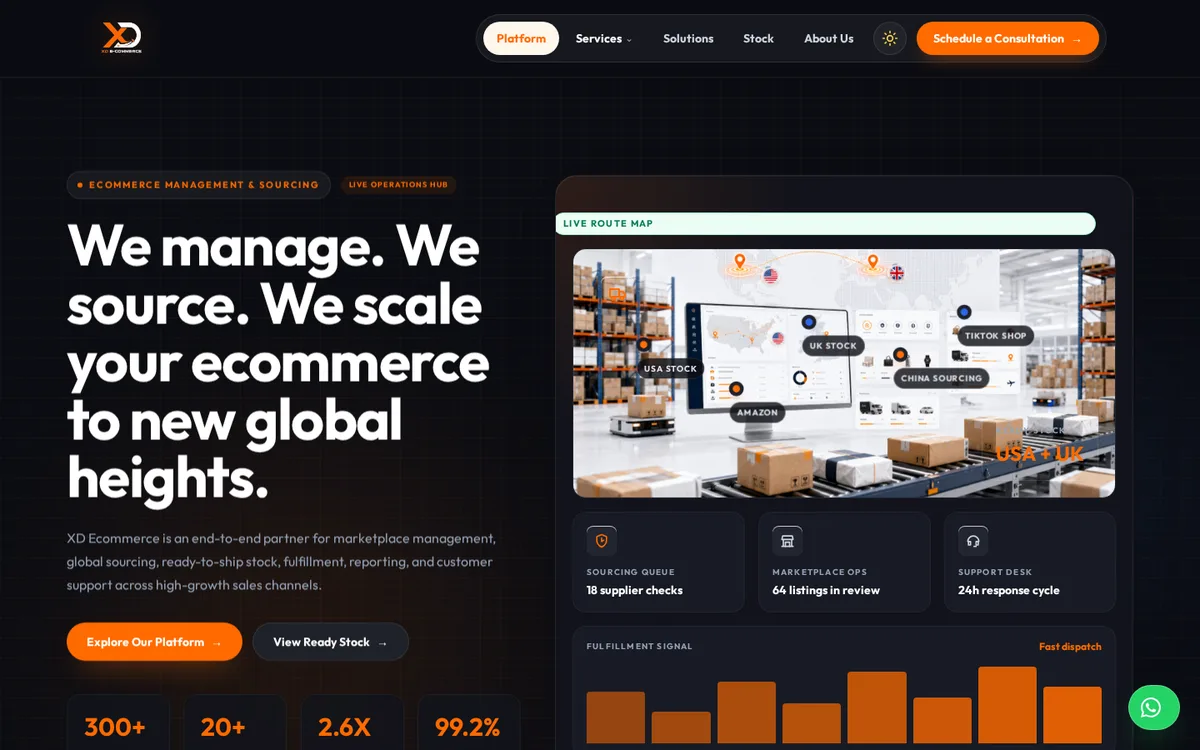
Operix builds online stores in Karachi and delivers US work remotely. We have no US office and no published US client. Our published work is chiefly for Pakistani and UAE clients, alongside some international projects, two of which are relevant here. XD Ecommerce is a website for an ecommerce management and sourcing company that runs Amazon, Walmart, TikTok Shop, eBay, Etsy and Shopify stores for brands. Zoya Couture is an online store for a new Belgian fashion label, in Dutch, French and English, with collections, wishlist, customer accounts and checkout.
The USA page explains the call hours and the ownership terms, and website development in the USA lists what a build includes. If you sell into more than one country, the global ecommerce checklist is the next read. To talk through your store, contact us.
Questions people ask
How does an online store charge the right sales tax in each state?
It sends the delivery address and the cart to a tax service at checkout and charges the amount returned. Which states you are required to collect in is not for the software to decide; confirm with your tax adviser.
Should a US store use Shopify or a custom build?
Start with Shopify or a similar platform unless your catalogue, pricing or stock integration does not fit it. Custom is worth it when you would otherwise be working around the platform every day.
Which payment methods does a US store need?
Cards, Apple Pay and Google Pay, PayPal, and usually a buy now pay later option. Each is switched on inside the payment processor. Hold that processor account yourself, not through your developer.
Can ecommerce developers outside the US build a store for American customers?
Yes. The store, the tax service, the payment processor and the carriers are all set up online. What matters is that the accounts are yours and that test orders are placed to real US addresses before launch.
How much does ecommerce website development cost?
The platform, the size of the catalogue, the integrations and the design work all move the figure. We publish no prices, so request a written quote.