
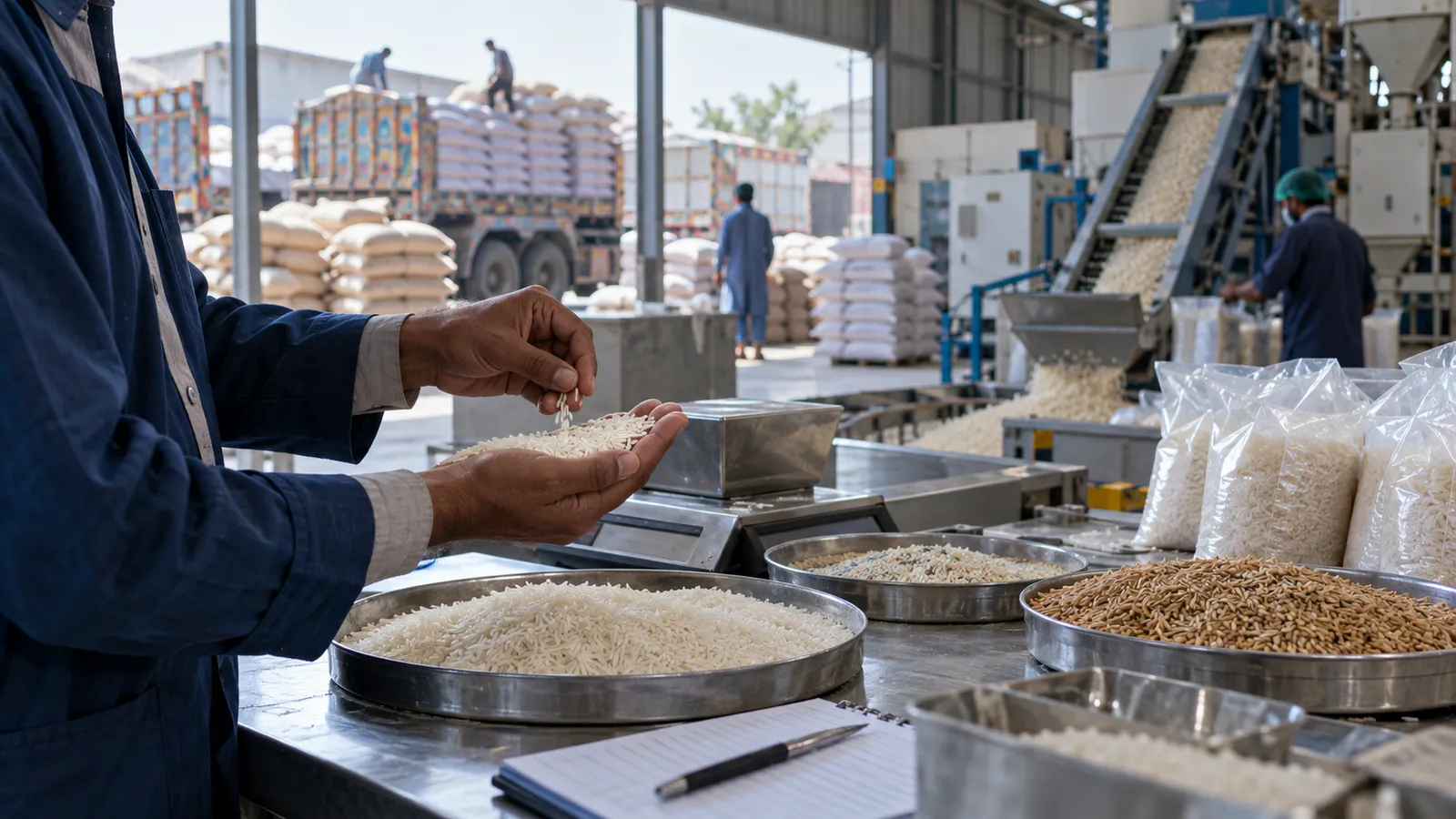
Rice mills around Gujranwala, Sheikhupura and Larkana, flour mills in every city, spice units in Karachi's SITE and Korangi, and pulse and dry-fruit processors near Jodia Bazaar all live by the crop calendar. You buy heavily at harvest, store for months, process in batches through the year, and sell through distributors and wholesalers who want credit. A notebook and an accountant can keep up for a while. Then you open a second godown, add a packing line, and the numbers stop agreeing.
What changes when crop becomes product
A tonne of paddy or wheat is not a tonne of product. Moisture comes off, husk, bran, broken grain and dust come out, and spices lose weight in drying and grinding. The ERP's job is to record each step honestly so the cost of a kilo of packed product reflects what was actually lost, and so by-products are counted and sold, not forgotten in a corner of the mill.
| Unit | Raw lot recorded with | Outputs to track |
|---|---|---|
| Rice mill | Paddy variety, weight, moisture, supplier or arhti | Head rice by grade, brokens, rice bran, husk |
| Flour mill | Wheat weight, moisture, source | Flour by type, maida, suji, bran (chokar) |
| Spice unit | Whole spice, weight, moisture, origin, lot | Ground and blended spices by pack size, rejected material |
| Pulses and dry fruit | Weight, grade, origin | Cleaned and sorted grades, rejects, packed sizes |
Buying in season
At harvest you deal with farmers, arhtis and brokers, often with advances paid weeks earlier. Each purchase is weighed at the kanta, sampled for moisture and graded, and paid with deductions agreed on the spot. The ERP records the gross and net weight, the deductions, the advance adjusted, and the balance owed. If your raw material comes through commission agents, see our guide to agri input dealer software for how advances and recoveries look on the other side of the deal.
Batches, recipes and yield
Each production run gets a batch number. For milling, the batch records raw lots issued and the weight of each output. For spice blends, the batch follows a recipe: which spices, in what share, ground to what mesh. When a batch closes, the system shows yield against the standard you set. A batch with low yield points to wet raw material, a machine problem or careless recording, and you find out the same week.
- Batch number printed on every pack, so a market complaint traces back to raw lots.
- Recipe versions kept, so a blend changed for cost reasons is not forgotten.
- By-products booked into stock with their own price for sale to feed mills or traders.
- Moisture and grade at intake compared with output yield over the season.
Godowns and stock age
Seasonal stock sits in godowns for months. The ERP holds each lot with its location, intake date and grade, so the oldest stock is used first and lots that need fumigation or re-drying are visible. Stock counts can be done godown by godown on a phone. For a deeper look at stock across sites, see inventory management software.
Selling to distributors
Packed product goes to distributors and wholesalers, often on credit and through salesmen who book orders on routes. The ERP's sales side should handle price lists per customer, schemes, credit limits and recoveries. Our distribution software guide and the salesman order booking app cover that in detail. FBR collects sales tax on goods; which of your products are taxed, and how, is for your tax adviser to confirm.
Number your raw lots
From the next delivery, give every lot a number with weight, moisture and grade at the kanta.
List your outputs
Write down every product and by-product that leaves the mill, with the unit you sell it in.
Set standard yields
Agree what yield a normal batch should give for each raw material, from your own experience.
Record one batch end to end
Run one batch with every input and output weighed and entered, and check it with the mill manager.
Review weekly in season
During processing season, review yields every week and chase the batches that fell short.
Cash matters too: distributors pay late in the off season, so the sales ledger and the season's raw stock should be read together when you plan the next harvest's buying.
How Operix helps
Operix builds ERP software for Pakistan from Karachi, on site for Karachi units and online for mills in Punjab and interior Sindh. We design the screens with you, release weekly on your own lots, and train staff in Urdu. See our manufacturing industry page, or book a demo with one season's purchase register in hand.
Questions people ask
Can the ERP work offline at the mill?
Yes. Entries at the kanta and on the floor can be saved on the device and sync when the internet returns, which matters during load shedding and in rural areas.
Can it handle advances to farmers and arhtis?
Yes. Advances are recorded per supplier and adjusted against deliveries, with the balance shown on their statement.
Does it support food safety audits?
It keeps batch, raw lot and recipe records that auditors usually ask for. What a specific certification requires should be confirmed with your auditor.
Do you have an office near our mill in Punjab?
No. Operix works from Old Clifton, Karachi. Mills outside Karachi are served online, with visits when the project needs them.
How much does a food processing ERP cost?
It depends on modules, sites, users and integrations such as weighbridges. Operix does not publish prices; you get a written quote after discovery.